If you’ve ever laid awake at 2 a.m. running through every possible worst-case scenario, you already know that worry doesn’t just live in your mind — it lives in your chest, your stomach, and your ability to fall asleep. The good news is that Scripture doesn’t just tell us to “stop worrying.” It gives us specific, practical truths to stand on when anxiety creeps in.
Below are 15 Bible verses about worry, each paired with a real, practical application you can use today — not just a nice thought to read and forget.

Quick-Reference: 15 Verses at a Glance
| # | Verse | Core Theme | Practical Action |
|---|---|---|---|
| 1 | Philippians 4:6-7 | Prayer replaces worry | Turn the worry into a prayer immediately |
| 2 | Matthew 6:34 | Live one day at a time | Ask “what does today actually require?” |
| 3 | 1 Peter 5:7 | Cast your cares on God | Physically name and hand over the worry |
| 4 | Matthew 6:26-27 | God’s provision | List past provisions before predicting future lack |
| 5 | Psalm 55:22 | Sustaining grace | Use a daily “cast” ritual |
| 6 | Proverbs 12:25 | Words can lift anxiety | Share the worry with a trusted person |
| 7 | John 14:27 | Christ’s peace vs. world’s peace | Distinguish fear-based thoughts from truth-based ones |
| 8 | Isaiah 41:10 | God’s presence and strength | Recite this verse during panic moments |
| 9 | Psalm 94:19 | Comfort in inner turmoil | Journal the anxious thought, then the comfort |
| 10 | Romans 8:28 | God works all things for good | Look back for a “good” that came from a past trial |
| 11 | Proverbs 3:5-6 | Trust over understanding | Stop demanding to know the “why” before obeying |
| 12 | Psalm 34:4 | Deliverance from fear | Pray specifically, not vaguely |
| 13 | 2 Timothy 1:7 | Spirit of power, not fear | Identify if a fear is from God or from the enemy |
| 14 | Luke 12:25-26 | Worry is unproductive | Redirect worry-energy into one small action |
| 15 | Psalm 23:4 | God’s presence in dark valleys | Personalize the psalm with your current situation |
1. Philippians 4:6-7 — Prayer Replaces Worry
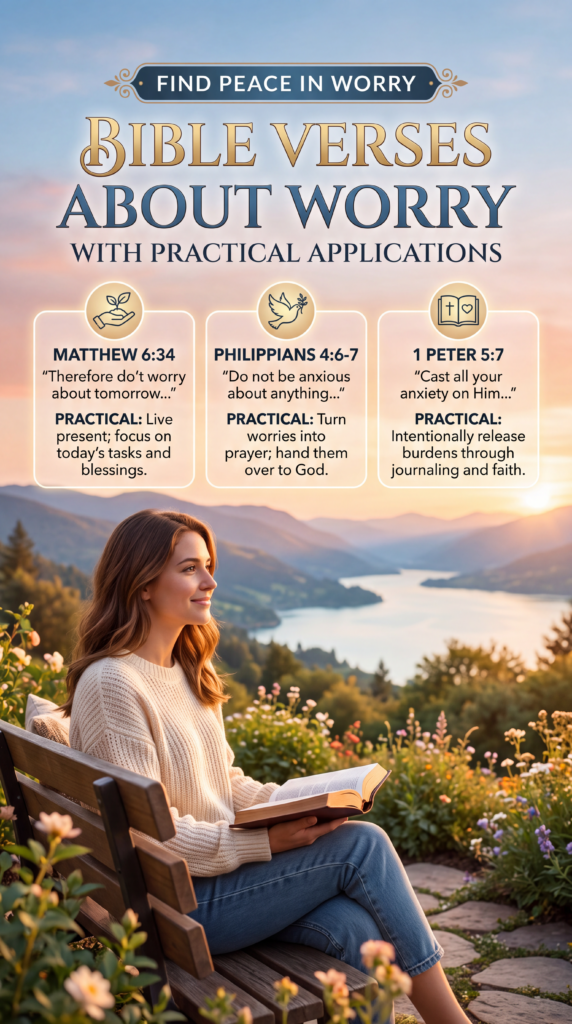
“Do not be anxious about anything, but in every situation, by prayer and petition, with thanksgiving, present your requests to God. And the peace of God, which transcends all understanding, will guard your hearts and your minds in Christ Jesus.”
This is likely the most quoted anxiety verse in the Bible, and for good reason — it gives a direct action step: prayer instead of anxiety.
Practical application: The next time you notice a worried thought forming, don’t just try to think positive. Immediately turn it into a spoken or written prayer, including one specific thing you’re thankful for in that same moment. This interrupts the anxiety loop before it builds momentum.
2. Matthew 6:34 — Live One Day at a Time
“Therefore do not worry about tomorrow, for tomorrow will worry about itself. Each day has enough trouble of its own.”
Most worry isn’t about today — it’s about a future that hasn’t happened yet.
Practical application: When you catch yourself spiraling into “what if” scenarios about next week or next year, ask: “What does today actually require of me?” Make a short list of only today’s tasks. This trains your mind to stay in the present, where you actually have agency.
3. 1 Peter 5:7 — Cast Your Cares on Him
“Cast all your anxiety on him because he cares for you.”
The word “cast” implies an active, physical motion — not a passive hope that worry will fade.
Practical application: Try a “casting ritual.” Write the specific worry on a sticky note or scrap of paper, say a short prayer handing it to God, and physically throw it away or tear it up. The physical act reinforces the mental and spiritual transfer.
4. Matthew 6:26-27 — God’s Provision for the Birds
“Look at the birds of the air; they do not sow or reap or store away in barns, and yet your heavenly Father feeds them. Are you not much more valuable than they? Can any one of you by worrying add a single hour to your life?”
Jesus uses a simple, observable example — birds — to make a bigger point about worry’s uselessness and God’s provision.
Practical application: Keep a running list titled “Times God Provided.” Every time you look back and see how a past worry was resolved or provided for, add it to the list. Read it whenever a new worry appears — it becomes evidence against the lie that this time will be different.
5. Psalm 55:22 — Sustaining Grace
“Cast your cares on the Lord and he will sustain you; he will never let the righteous be shaken.”
Notice the promise isn’t that trouble disappears — it’s that you will be sustained through it.
Practical application: Instead of praying only “remove this,” add “sustain me through this” to your prayers. This shifts your expectation from instant fixes to daily strength, which is usually how God actually works.

6. Proverbs 12:25 — Words Can Lift Anxiety
“Anxiety weighs down the heart, but a kind word cheers it up.”
Worry often grows in isolation. Proverbs points to community and conversation as part of the remedy.
Practical application: When anxiety hits, text or call one trusted person and say the worry out loud instead of just replaying it internally. Isolation feeds anxiety; being known interrupts it.
7. John 14:27 — Christ’s Peace vs. the World’s Peace
“Peace I leave with you; my peace I give you. I do not give to you as the world gives. Do not let your hearts be troubled and do not be afraid.”
Worldly peace depends on circumstances being fine. Christ’s peace is available even when circumstances are not fine.
Practical application: When you feel anxious, ask yourself: “Is this thought based on truth, or based on fear predicting the worst?” Separating fact from fear-driven assumption helps you respond to reality instead of a worst-case fantasy.
8. Isaiah 41:10 — God’s Presence and Strength
“So do not fear, for I am with you; do not be dismayed, for I am your God. I will strengthen you and help you; I will uphold you with my righteous right hand.”
This verse was given to people facing real, tangible threats — not abstract worry.
Practical application: Memorize this verse so it’s available in the moment panic strikes, not just when you have time to read your Bible. Say it out loud during a panic moment; speaking truth aloud can interrupt escalating anxious thoughts.
9. Psalm 94:19 — Comfort in Inner Turmoil
“When anxiety was great within me, your consolation brought me joy.”
This verse acknowledges that anxiety is real and heavy — it doesn’t minimize the feeling.
Practical application: Keep a two-column journal: one side for the anxious thought, the other for a specific comfort (a verse, a memory of God’s faithfulness, a truth) that counters it. Over time this becomes a written record of God meeting you in anxious moments.
10. Romans 8:28 — God Works All Things for Good
“And we know that in all things God works for the good of those who love him, who have been called according to his purpose.”
This isn’t a promise that everything is good — it’s a promise that God can work good through hard things.
Practical application: Think of one past situation that felt unbearable at the time but later produced growth, a lesson, or an unexpected blessing. Write it down. Use it as evidence the next time a new worry claims “this will only end badly.”
11. Proverbs 3:5-6 — Trust Over Understanding
“Trust in the Lord with all your heart and lean not on your own understanding; in all your ways submit to him, and he will make your paths straight.”
Much worry comes from demanding to understand every detail before we’re willing to move forward.
Practical application: Identify one decision or situation you’ve been stuck on because you don’t have “enough information.” Take the next small, faithful step anyway, trusting that clarity often comes after obedience, not before it.
12. Psalm 34:4 — Deliverance from Fear
“I sought the Lord, and he answered me; he delivered me from all my fears.”
David isn’t describing distant, vague hope — he’s describing a specific answer to a specific prayer.
Practical application: Instead of praying generally (“help me not be anxious”), name the exact fear specifically in prayer (“I’m afraid I’ll lose my job” or “I’m afraid this diagnosis will be bad”). Specific prayers are easier to track answers to, which builds faith over time.
13. 2 Timothy 1:7 — A Spirit of Power, Not Fear
“For the Spirit God gave us does not make us timid, but gives us power, love and self-discipline.”
This verse draws a line between fear that paralyzes and the Spirit’s influence, which empowers.
Practical application: When fear arises, ask: “Is this fear pointing me toward wisdom and caution, or is it paralyzing me from acting at all?” Healthy caution is different from anxiety-driven avoidance — this verse helps you tell the difference.
14. Luke 12:25-26 — Worry Is Unproductive
“Can any one of you by worrying add a single hour to your life? Since you cannot do this very little thing, why do you worry about the rest?”
Jesus points out a hard truth: worry has never actually solved anything.
Practical application: Next time you notice yourself worrying about something, ask: “Is there one small, concrete action I can take right now?” If yes, do it. If no, consciously set the thought down — worrying further changes nothing.
15. Psalm 23:4 — Presence in Dark Valleys
“Even though I walk through the darkest valley, I will fear no evil, for you are with me; your rod and your staff, they comfort me.”
This verse doesn’t promise an easy path — it promises companionship through the hard one.
Practical application: Personalize this verse by inserting your current situation: “Even though I walk through [job loss / health scare / financial stress], I will fear no evil, for you are with me.” Praying it this way makes an ancient psalm feel immediately relevant.
How to Actually Use These Verses (Not Just Read Them)
Reading a list of verses about worry can feel encouraging for about five minutes — and then the anxious thoughts come right back. Here’s how to make these verses part of an actual habit:
- Pick 2-3, not all 15. Choose the verses that speak most directly to your current situation and focus on those.
- Write them somewhere visible. A sticky note on your mirror, a phone lock screen, or a notecard in your wallet works better than a verse you read once in an app.
- Pair each verse with the practical action, not just the words. The application is what turns a memorized verse into a changed response.
- Expect to repeat this daily. Anxiety rarely responds to a one-time fix — these become tools you return to again and again.

FAQ
What is the best Bible verse for anxiety and worry? Philippians 4:6-7 is the most commonly cited because it gives both the command (don’t be anxious) and the specific action (prayer with thanksgiving) in the same passage.
Does the Bible say worrying is a sin? Scripture doesn’t frame anxiety as a moral failure to be ashamed of — many biblical figures, including David, expressed real fear and distress. Instead, the Bible consistently redirects worry toward trust, prayer, and God’s presence rather than condemning the person feeling it.
How can I stop worrying using Scripture? Memorizing a verse is a start, but pairing it with a specific action — like praying immediately, journaling the anxious thought next to a truth, or naming the fear specifically — makes the verse practical rather than just informational.
What does the Bible say about worrying about the future? Matthew 6:34 directly addresses this, encouraging believers to focus on today’s needs rather than borrowing trouble from a future that hasn’t arrived yet.
Can prayer actually reduce anxiety? Philippians 4:6-7 promises that prayer, paired with thanksgiving, results in a peace that “transcends understanding.” Many believers find that verbalizing a worry to God — rather than just replaying it mentally — reduces its intensity.
Final Thoughts
Worry isn’t something you defeat once and never deal with again — it’s something you bring to God, again and again, one anxious thought at a time. These 15 verses aren’t meant to be a magic formula, but a toolkit: truths to stand on, prayers to pray, and small actions to take the next time your mind starts spinning toward the worst-case scenario.
Start with just one verse this week. Write it down, pray it specifically, and watch how it changes not just what you think, but how you respond.